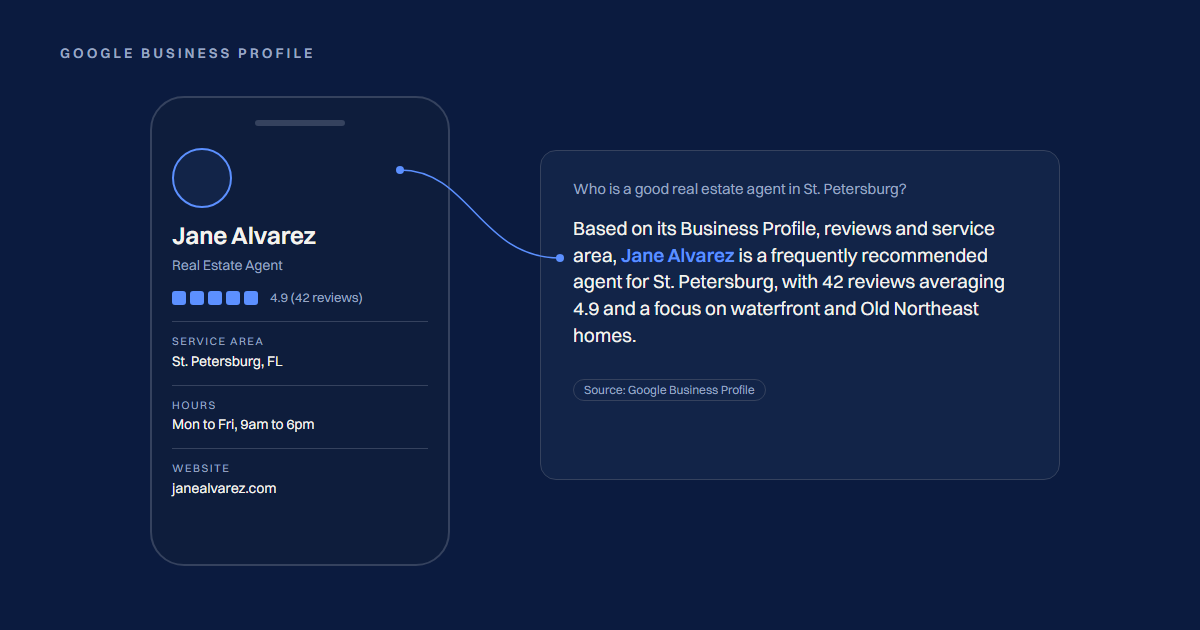
Your Google Business Profile, formerly Google My Business, is the single largest source AI engines cite when someone asks for a real estate agent. In Local Falcon's August 2026 study of 37,500 AI searches across the 100 largest US cities, Google Business Profile listings accounted for 36.6 percent of all citations, more than Zillow, Realtor.com and agents' own websites put together. Inside Google's AI Mode specifically, Business Profile listings supplied 72.5 percent of that one engine's citations. A Google Business Profile for real estate agents is not a Maps listing with a phone number anymore. It is the document AI reads first when it decides whose name to say.
This guide is for the agent who has never claimed a profile, the one who suspects theirs is set up wrong, and the team lead deciding whether it is worth an afternoon. It covers what Google's guidelines actually permit for agents, which fields AI reads, and what a profile cannot do.
Why Google Business Profile Matters More for AI Than for Maps
Local Falcon ran best realtor near me and two similar phrases through five AI platforms across the 100 largest US cities in August 2026, 37,500 searches in all, then traced where every answer got its information. Google Business Profile was the top source at 36.6 percent of citations. Zillow followed at 15.9 percent, FastExpert at 6.3, Realtor.com at 5.7. Agents' own websites, combined, made up roughly one citation in nine.
The split by platform is what should change how you spend your time. Google's AI Mode drew 72.5 percent of its citations from Google Business Profile listings. ChatGPT pulled 39.8 percent of its citations from Zillow. Gemini leaned on agents' own websites more than any other platform. There is no single place to be. There is a biggest one, and it is the profile you may have set up in 2019 and not opened since.
The audience is already asking. BrightLocal's 2026 survey found 45 percent of US adults had used an AI tool for a local business recommendation in the past year, up from 6 percent a year earlier.
Three objections come up here.
My brokerage handles this. Your brokerage's profile is the brokerage's entity, not yours. Compass appears in 86 of the 100 cities studied and draws more citations than the next two brands combined. Every one of those says Compass.
I already pay for SEO. Most SEO retainers work on your website. Your website is one citation in nine. The profile is one in three.
AI just cites Zillow anyway. Mostly it cites Zillow's city directory pages: 86.9 percent of Zillow citations pointed to a list of agents in a city rather than any individual's profile. AI uses Zillow to say where to look, not who is good.
Can a Real Estate Agent Have a Google Business Profile
Yes. Google's guidelines name real estate agents explicitly as individual practitioners, alongside doctors, lawyers and insurance agents, and practitioners may hold their own dedicated Business Profile.
Two conditions apply. You have to operate in a public-facing role with your own client base, and you have to be reachable at the verified location during the hours you list. Support staff cannot have profiles. Neither can sales associates or lead-generation agents working for a corporation, which excludes a salaried employee at a builder's sales center. One more limit trips up specialists: one profile per practitioner, not one per specialty.
AI systems resolve entities. When Gemini or AI Mode answers a question about a good agent in St. Petersburg, it is matching a name to facts it can verify: a category, a location, a phone number, a body of reviews. A practitioner profile is the cleanest package of those facts that exists for an individual agent. Without one, the model tends to name the brokerage instead of you.
Your Name or Your Brokerage's Name
For most agents the answer is your name only. Google's rule turns on how many public-facing agents share your location.
If you are one of several agents at an office, the brokerage creates its own profile for the location and your practitioner profile carries only your name. Google's guideline says the practitioner's title should not include the organization's name. Jane Alvarez is correct. Jane Alvarez, Compass is not. Jane Alvarez, Compass, St. Petersburg Realtor is a suspension waiting to happen.
The exception is the solo practitioner who is the only public-facing person at a franchised office. Google asks that agent to share one profile with the brand, formatted as brand, colon, name. Its own example is Allstate: Joe Miller.
A title or certification is allowed; Dr. and Esq. are Google's examples. What is not allowed is anything that belongs in another field: service words such as Realtor, location words such as your city, taglines, phone numbers. Google lists each as grounds for suspension. The advice to add a city and the word Realtor to your business name is still common in agent marketing content. It violates the policy.
Your profile name is also the string AI repeats back. If you are Jane Alvarez on Google, Jane Alvarez, Compass on Zillow and The Alvarez Group on your website, a model has three candidate entities and weaker confidence in each. Use the name on your license everywhere.
What Address Do You Use
If clients do not walk into an office to meet you, hide the address and set a service area. That is Google's rule for any service-area business, and it describes most agents.
A business that travels to customers keeps its address off the public profile and defines the area it serves, which should not stretch beyond roughly two hours of driving from where it is based. You still verify with a real address, which can be your home, but the map pin stays private. It also keeps you out of a duplicate-location fight with every other agent verified at the same brokerage suite.
The brokerage address is permitted only if it is true: a practitioner must be contactable there during stated hours, and any address shown needs permanent signage for the name on the profile. If you drop in on Tuesdays, do not list it.
Two addresses are never acceptable: a virtual office, meaning a rented mailing address you do not work from, and a co-working space without your own signage and staff present during business hours. P.O. boxes fail on sight. Whatever you choose, match it on Zillow, Realtor.com and your own site. A suite number that appears in one place and not another is a small crack, and models fall through small cracks.
Setting Up a Google Business Profile for Real Estate Agents Field by Field
Primary category
Choose Real Estate Agent. Real Estate Agency is the brokerage's category and puts you in competition with offices rather than individuals. Google's test is that the business IS a thing, not that it HAS a thing, and it asks for the fewest categories that describe your core work. Add a second category only if you would describe yourself that way to a stranger, never as a keyword.
Hours
Google says appointment-only businesses should not list hours, but a practitioner must be reachable during the hours stated. List the hours you genuinely answer your phone. Listing 24 hours when you do not pick up at two in the morning tells Google, and every AI reading it, something false.
Phone and website
Use a number you control that rings to you, not the brokerage's main line, and your own website, not the brokerage homepage. Google requires the phone to connect to the individual business and prohibits redirecting numbers or URLs.
Description
You have 750 characters, and Google prohibits links, promotions and prices. Write the two sentences you want an AI to repeat: who you are, where you work, what you are known for. Jane Alvarez has sold residential real estate in St. Petersburg since 2011, with a focus on waterfront and Old Northeast homes, gives a model four verifiable facts. Passionate about helping clients achieve their dreams gives it nothing.
Services and photos
List what you do, not where. Buyer representation, listing and marketing, relocation, investment property. Agents who fill the Services or Products fields with property addresses hand AI a stale inventory instead of a description of their practice. Use a current headshot and recent closed listings for photos, not stock imagery.
Reviews Are the Text AI Repeats
Reviews are the only part of your profile written by someone other than you, which is exactly why AI weights them.
When AI Mode or Gemini describes an agent, the adjectives come from review text. If ten reviews say responsive, the model says responsive. If three mention first-time buyer and two mention Snell Isle, the model learns what you do and where. Great agent, five stars is pleasant and nearly useless to a machine matching you to a specific question.
Ask for specifics at the closing table: what neighborhood, what kind of transaction, what problem you solved. You cannot script the review, but you can ask the question that produces a useful one. Respond to every review, too. BrightLocal found 97 percent of AI users at least sometimes check an AI recommendation against real reviews, so the profile a model points to is the profile the client reads next.
One limit to be honest about. BrightLocal's co-founder Myles Anderson noted in the 2026 report that ChatGPT and similar models "can't see inside Google's walled garden of reviews." Google reviews carry enormous weight in Google's own AI products and much less in ChatGPT. They are necessary. They are not sufficient.
Why Google AI Mode Shows Some Agents and Not Others
Because AI Mode reads Google Business Profile almost exclusively, and most agents' profiles give it nothing to work with.
The 72.5 percent figure is most of the explanation. AI Mode is not scanning the open web for opinions about you. It is reading Google's own structured record: category, service area, hours, description, review count, review recency, review text. A complete practitioner profile with thirty specific reviews is legible to it. An unclaimed listing auto-generated from a brokerage roster is not.
That is also why production volume does not show up. Local Falcon compared the highest-volume agents in each city to the names AI returned. Only 21.2 percent of those top producers were cited by any AI platform, and 91.5 percent of website-publishing agents were never named at all. Closing 80 homes a year lives in your MLS and your brokerage's press release. It does not live anywhere AI Mode reads.
The platforms disagree with each other too. Of the 3,757 agents named in the study, 82.6 percent were cited by exactly one platform. A related pattern turned up when AI Search Masters put the Tampa market to four engines in September 2026: two of them answered partly with company names, Signature Realty Associates, RE/MAX Dynamic and LPT Realty among them, rather than with people. An engine that cannot resolve an individual falls back on the firm. A practitioner profile is what gives it an individual to resolve.
What a Google Business Profile Cannot Fix
A complete profile addresses roughly a third of the citation problem and nearly three quarters of the Google AI Mode problem.
ChatGPT, the most used AI tool for local recommendations, draws 39.8 percent of its agent citations from Zillow and leans on portals generally. Gemini reads agents' own websites more than any other platform. FastExpert, which most agents have never claimed a profile on, accounted for 6.3 percent of all citations, more than Realtor.com. A Google profile does nothing for any of that.
Which sources those are, and how each engine weights them, is the subject of a separate guide to the directories AI checks.
And to be direct about the commercial part: setting up the profile described here is free and takes an afternoon. You do not need an agency for it, and any agency that says otherwise is selling you your own homework. Where it gets harder is what comes after: keeping name, address, phone and category identical across Google, Zillow, Realtor.com, FastExpert, Yelp and the dozens of other directories AI reads, and finding the listings you did not know existed. That is the work our Clean-Up service does. The profile itself is yours to fix today.
Frequently Asked Questions
Yes, Google's guidelines list real estate agents as individual practitioners eligible for their own Business Profile. You need a public-facing role with your own clients and to be reachable at your verified location during stated hours. Salaried sales associates for corporations are not eligible.
Use your name only if you are one of several agents at your office, which describes most agents. Google's guideline says a practitioner's profile title should not include the organization's name. The exception is a solo agent at a branded office, who shares one profile formatted as brand, colon, name.
If you meet clients at properties rather than at an office, verify with a real address, then hide it and set a service area within about two hours of driving from your base. Use the brokerage address only if you are genuinely reachable there during stated hours. Virtual offices and P.O. boxes are not eligible.
Yes, and more than any other single source. In Local Falcon's August 2026 study of 37,500 AI searches for real estate agents, Google Business Profile accounted for 36.6 percent of all citations and 72.5 percent of Google AI Mode's citations. Its influence on ChatGPT is smaller, because ChatGPT cannot read Google's reviews directly.
Because AI Mode draws almost three quarters of its citations from Google Business Profile, agents with complete practitioner profiles are visible to it and agents with unclaimed or thin profiles are not. Sales volume does not factor in; only 21.2 percent of the highest-producing agents in the Local Falcon study were cited by any AI platform.
Go to business.google.com, create a profile under your own name with no title words or city attached, and choose Real Estate Agent as the primary category. Verify with a real address and hide it if you do not meet clients at an office. Add your own phone and website, write a 750-character description naming your market and specialty, and ask closed clients for reviews that mention the neighborhood and transaction type.
Start With the Profile
A Google Business Profile for real estate agents is the one AI source you control completely, for free, and it is the largest one there is. Set it up under Google's actual rules, name only, right category, honest hours and address, and you have fixed the biggest single input to what Google's AI says about you. To see what every engine currently returns for your market, AI Search Masters runs a free check that shows the names that come back, and whether yours is one of them.
| support@aisearchmasters.com | |
| Office | St. Petersburg, Florida |
| Hours | By appointment |
Sources
| Source | Used for |
|---|---|
| Local Falcon, The Realtor AI Visibility Index | Google Business Profile at 36.6 percent of AI citations; study design of 37,500 searches across 100 US cities in August 2026; 21.2 percent of top producers cited; 91.5 percent of website-publishing agents never cited; source shares for Zillow, FastExpert and Realtor.com. |
| Inman, When You Ask AI For The Best Agent, Top Producers Often Lose Out | Google AI Mode at 72.5 percent of citations from Google Business Profile; ChatGPT at 39.8 percent from Zillow; 86.9 percent of Zillow citations pointing to city directory pages; 82.6 percent of agents cited by one platform only; 72 agents named by all four. |
| Google Business Profile Help, Guidelines for representing your business on Google | Individual practitioner eligibility for real estate agents; practitioner name rules; the Allstate: Joe Miller format; business name restrictions; service-area address rules and the two-hour limit; virtual office and co-working restrictions; category, hours, phone and description requirements. |
| BrightLocal, Nearly Half of Consumers are Asking AI for Business Recommendations | 45 percent of consumers using AI for local recommendations, up from 6 percent; ChatGPT at 31 percent and Google AI Mode at 23 percent; 64 percent of adults aged 30 to 44; 97 percent of AI users checking recommendations against reviews; Myles Anderson on Google's reviews. |