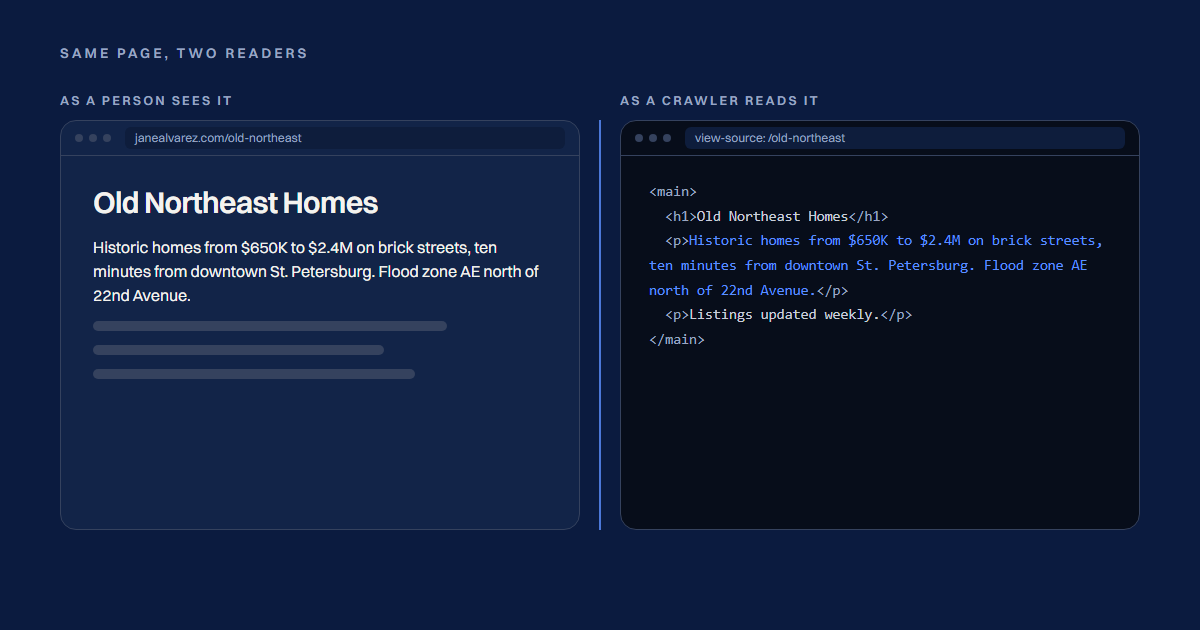
Real estate agent website design for AI comes down to one question: can a machine that runs no JavaScript read the words on your neighborhood page? Your website matters to AI less than most vendors say and more than the citation share suggests. In Local Falcon's August 2026 study of 37,500 AI searches across the 100 largest US cities, agents' own websites supplied roughly one citation in nine, well behind Google Business Profile and Zillow. But Gemini pulled more from agents' sites than any other engine, an agent only counted as named when AI linked to their own site or a profile carrying their name, and the site is the one asset in the whole stack you own outright.
This guide is for the agent whose site ranks fine on Google and never appears in ChatGPT, and for the team lead deciding whether a rebuild is worth the money. It covers what AI crawlers can read, the pages that do the work, what schema and llms.txt actually do, when not to rebuild, and how to measure the result.
Does Your Website Matter If AI Mostly Cites Zillow
Yes, for three reasons the citation share hides.
The first is Gemini. Local Falcon found Gemini pulled more from agents' own websites than any other platform, while ChatGPT leaned on Zillow and Realtor.com and Google AI Mode read almost nothing but Business Profile listings. If Gemini is going to name you, your site is where it looks.
The second is how being named works at all. The study counted an agent as named only when AI linked to the agent's own website or to a profile page carrying their name. The most-cited agent domains in the study are agent websites, in Las Vegas, Tulsa, Tampa, Kansas City and Indianapolis among others. The portals are where AI looks for a list. Your site is where it goes to say something specific about you.
The third is ownership. Zillow can change how its directory ranks agents. Google can change what its AI reads from a Business Profile. FastExpert can change its referral terms. Your site is the only place where the words about you were written by you and can be rewritten by you tomorrow.
Two objections come up here. An SEO retainer does not cover this, because Google renders JavaScript and most AI crawlers do not, so a page can rank first on Google and be a blank shell to ChatGPT. And the brokerage site does not cover it either, because when AI cites a brokerage domain it names the brokerage. Compass appears in 86 of the 100 cities studied and draws more citations than the next two brands combined. Those went to Compass.
What Makes a Real Estate Website Readable by AI
Three things, in order: the crawler is allowed in, the words are in the HTML, and the page answers a question in its first lines.
The crawler is allowed in
AI engines read the web with their own crawlers: GPTBot and OAI-SearchBot for OpenAI, ClaudeBot for Anthropic, PerplexityBot, and for Gemini the Google-Extended control that rides on Googlebot. Your robots.txt file decides whether they may enter. Many agent sites have not touched that file in years.
Hosting can block them too. In July 2025 Cloudflare, which sits in front of a large share of the web, began blocking AI crawlers by default for new domains, and in July 2026 it split that control into three categories: Search, Agent and Training. Under its current defaults for new domains, Search crawlers stay allowed while Training and Agent crawlers are blocked on pages that display ads. If your site runs behind Cloudflare, someone should check what those settings say for your domain.
The words are in the HTML
This is the gap that decides most cases. Google's crawler executes JavaScript and indexes the page a browser would show. In Vercel's analysis of crawler traffic across its network, none of the major AI crawlers did. GPTBot downloaded JavaScript files in about 11.5 percent of its requests and never ran them. Claude's crawler downloaded them in about 23.8 percent of requests and never ran them either. Gemini is the exception, because it inherits Google's rendering.
Most agent websites are built on templates that load listings, neighborhood copy and sometimes the whole page body through JavaScript after the initial response. To a person that is a website. To ChatGPT it is an empty container with a script tag. The test takes thirty seconds: open your neighborhood page, view the page source rather than the inspector, and search for a sentence from your copy. If it is not there, an AI crawler never saw it.
The page answers a question in its first lines
An AI system quoting a page takes the passage that answers the question directly. A neighborhood page that opens with a welcome to our beautiful community gives it nothing to lift. One opening with the price range, housing stock, school district and commute gives it four facts up front. Google's own guidance for its AI experiences asks for the same thing in different words: content that fulfills the need directly, with the main content easy to distinguish from everything else on the page.
Real Estate Agent Website Design, Page by Page
A site does four jobs for an AI system, and it needs at least one page doing each.
The entity page: The homepage names the agent or team, the market and the specialty in its first screen, in plain text. That sentence is what AI repeats back. If your name on the site is The Alvarez Group while your Business Profile says Jane Alvarez, the machine now has two entities to reconcile.
The trust page: About pages are where AI goes to justify a recommendation: years licensed, brokerage, designations, volume if you choose to publish it, and the neighborhoods you actually work. Written as facts, not as a bio about passion.
The geographic proof: One page per market you claim, each answering what a buyer asks about that specific place. This is the layer that makes AI say a name when someone asks about a particular neighborhood, and it is the layer most template sites do not have at all.
The question layer: Blog posts and FAQ pages shaped like the questions people type. Not market updates with a stock photo, but direct answers to whether a septic inspection is required in your county or what a flood zone rating changes about insurance.
That four-layer structure is what our AI Visibility Website is built around. AI Search Masters applied it to the Ruth Reffkin Team's site in Manhattan, where the homepage carries the entity, the About page the credentials, one page per neighborhood the geographic proof, and the blog the questions buyers actually ask. It is also a fair test of a site you already have. Count how many of the four jobs your current pages do in plain HTML. Most do one.
What Schema Markup Actually Does
Schema markup is structured data, usually JSON-LD, that labels what a page is about in a form machines can parse. It belongs on an agent site. What it does is more specific than the way it usually gets sold.
Google's position is the clearest. Its guidance on succeeding in AI Overviews and AI Mode says structured data is something its systems consider and that it makes pages eligible for certain search features, with the condition that everything in the markup is also visible on the page. That is a real benefit, since Google remains the largest single channel for finding a local business.
The evidence that schema lifts citations on its own is thinner. In May 2026 Ahrefs tracked 1,885 pages that added JSON-LD between August 2025 and March 2026, matched against 4,000 control pages, and measured no meaningful uplift on Google AI Overviews, AI Mode or ChatGPT. Two caveats the authors raise matter here. Every page in the sample was already heavily cited, so the test asked whether schema adds lift to pages that were already winning, and the window was 30 days. It is a study about a shortcut, not about whether the foundation is worth laying.
The honest reading is that schema is foundation rather than a growth lever. Its job on an agent site is entity resolution: a Person or RealEstateAgent entry whose name, brokerage, phone and service area match your Google Business Profile exactly, so an engine can tell that the site, the profile and the directory listings all describe one person. That is the same problem the rest of this series is about, and it is why schema belongs in the build rather than bolted on afterward. Add Article markup on guides and FAQPage on pages carrying a real FAQ, with every question and answer visible on the page. What schema will not do is rescue a page whose words are not in the HTML.
llms.txt and Page Speed, Two Short Answers
llms.txt
An llms.txt file is a plain text summary of your site placed at the root for AI systems to read. It is an emerging convention rather than a confirmed ranking signal. Ahrefs checked 137,210 domains in May 2026 and found 97 percent of the files that existed received zero requests, with most of the traffic they did get coming from SEO audit tools. Publish one anyway. It costs almost nothing, it is easy to keep current, and if the engines start reading it you are already compliant. Do not expect it to move anything on its own today.
Page speed
For Google's AI products, speed is part of page experience, which Google lists among the things that affect how content performs in AI Overviews and AI Mode, naming latency specifically. For the other engines the evidence is thinner, and the practical concern is different: a crawler served a slow, script-heavy response may never reach your text. A site that returns its words in the first response, quickly, is fast for the reasons that matter here.
When Not to Rebuild
A website rebuild is the most expensive item on an agent's AI visibility list and the smallest single citation share. That ordering should decide the sequence.
If your Google Business Profile is unclaimed or thin, fix that first. It carried 36.6 percent of all citations in the Local Falcon study and nearly three quarters of Google AI Mode's. If your Zillow, Realtor.com and FastExpert profiles are inconsistent or missing, fix those second. Together the directories carried around four citations in nine. A new website while those are broken is a new roof on a house with no foundation.
A rebuild is the right call when the view-source test fails, meaning your copy is not in the HTML; when your host or robots.txt is blocking AI crawlers and the vendor cannot or will not change it; or when the site has no market pages at all and the template cannot add them. Those are structural, and AI reads structure. AI Search Masters builds from the first line of code rather than redesigning, for exactly that reason.
How to Measure Success After Launch
Traffic is the wrong metric. The question a new site has to answer is whether AI now cites it, and that is measured by asking the engines.
Before launch, run the three phrases Local Falcon used, best realtor near me, best real estate agent near me and top rated real estate agent near me, with your city named. The study itself ran five platforms: ChatGPT, Google AI Overviews, Google AI Mode, Gemini and Grok. Add Perplexity and Claude to your own check if your buyers use them. Record which names appear and which pages each engine cites, then repeat monthly after launch. The first sign of success is your domain appearing as a cited source, even before your name appears in the answer. The study repeated every search at 25 points across each city because single runs vary, so run each phrase more than once.
Two secondary signals are worth watching. Referral traffic from chatgpt.com, perplexity.ai and gemini.google.com in your analytics shows people clicking through from AI answers. And BrightLocal's 2026 survey found 88 percent of AI users check the source an AI cites, so the pages AI links to will show a visit pattern of their own. Watch which of your URLs appear as sources, not just whether your name does.
Frequently Asked Questions
Three things: AI crawlers are allowed in by robots.txt and your host, the page's words are present in the raw HTML rather than loaded by JavaScript, and each page answers a specific question in its first lines. Vercel's analysis found none of the major AI crawlers execute JavaScript, so content that appears only after scripts run is invisible to ChatGPT, Claude and Perplexity.
Yes. Agents' own sites supplied about one citation in nine in Local Falcon's August 2026 study, but Gemini drew more from agents' sites than any other engine, and the most-cited agent domains in the study were agent websites. It is also the only source about you that you fully control.
Enough to do four jobs: a homepage that names you, your market and specialty in plain text, an About page with verifiable facts, one page for each market you claim, and a set of question-shaped guides or FAQs. A ten-page site that does all four is more useful to AI than a fifty-page template that does one.
A Person or RealEstateAgent entry that matches your Google Business Profile exactly, Article markup on guides, and FAQPage markup only on pages with a visible FAQ. Its job is entity resolution, making the site, the profile and the directory listings resolve to one person, so accuracy matters more than volume. Google requires structured data to mirror what is visible on the page.
For Google's AI Overviews and AI Mode, yes, because Google lists page experience, including latency, among the factors that affect how content performs there. For ChatGPT, Claude and Perplexity the evidence is thinner, and the larger risk is a script-heavy page whose text never appears in the initial HTML at all.
Yes, if the questions are ones buyers and sellers in your market actually ask and each answer starts with the answer. Question-shaped pages are the part of a site AI engines quote most readily. A generic FAQ about what a Realtor does adds nothing an engine does not already have.
Start With What the Crawler Sees
A real estate agent website design that AI can read passes one test: a crawler that runs no JavaScript fetches your neighborhood page and finds the words there. If it does, and the page answers something specific, you hold the one source about you that nobody else controls. To see which of your pages AI engines currently cite, and whether your name comes back at all, AI Search Masters runs a free check for your market.
| support@aisearchmasters.com | |
| Office | St. Petersburg, Florida |
| Hours | By appointment |
Sources
| Source | Used for |
|---|---|
| Local Falcon, The Realtor AI Visibility Index | Agents' own websites at roughly one citation in nine; Gemini drawing more from agents' sites than any platform; 91.5 percent of website-publishing agents never cited; the named-agent standard; most-cited agent domains; 36.6 percent Business Profile share; Compass at 1,510 citations. |
| Vercel, The Rise of the AI Crawler | None of the major AI crawlers render JavaScript; GPTBot fetching JavaScript files in about 11.5 percent of requests and Claude in about 23.8 percent without executing them; Gemini's exception via Google's rendering. |
| Cloudflare, Your Site, Your Rules | Default blocking of AI crawlers for new domains from July 2025; the July 2026 split into Search, Agent and Training categories and the defaults applied to each. |
| Google Search Central, Top Ways to Ensure Your Content Performs Well in Google's AI Experiences | Page experience and latency; ensuring Google can access content; structured data considered by Google's systems and required to match visible content. |
| Ahrefs, We Tracked 1,885 Pages Adding Schema | No meaningful citation uplift from adding JSON-LD across AI Overviews, AI Mode and ChatGPT; matched control design; the live-fetch test showing AI systems ignoring JSON-LD; study caveats. |
| Ahrefs, We Analyzed 137K Sites and 97 Percent of llms.txt Files Never Get Read | 97 percent of llms.txt files receiving zero requests in May 2026; requests dominated by audit tools; AI bots not requesting the file where absent. |
| BrightLocal, Nearly Half of Consumers are Asking AI for Business Recommendations | 88 percent of AI users checking the source or legitimacy of a review an AI cites. |